Forylis — Monstrous Religion
Contents
Overview
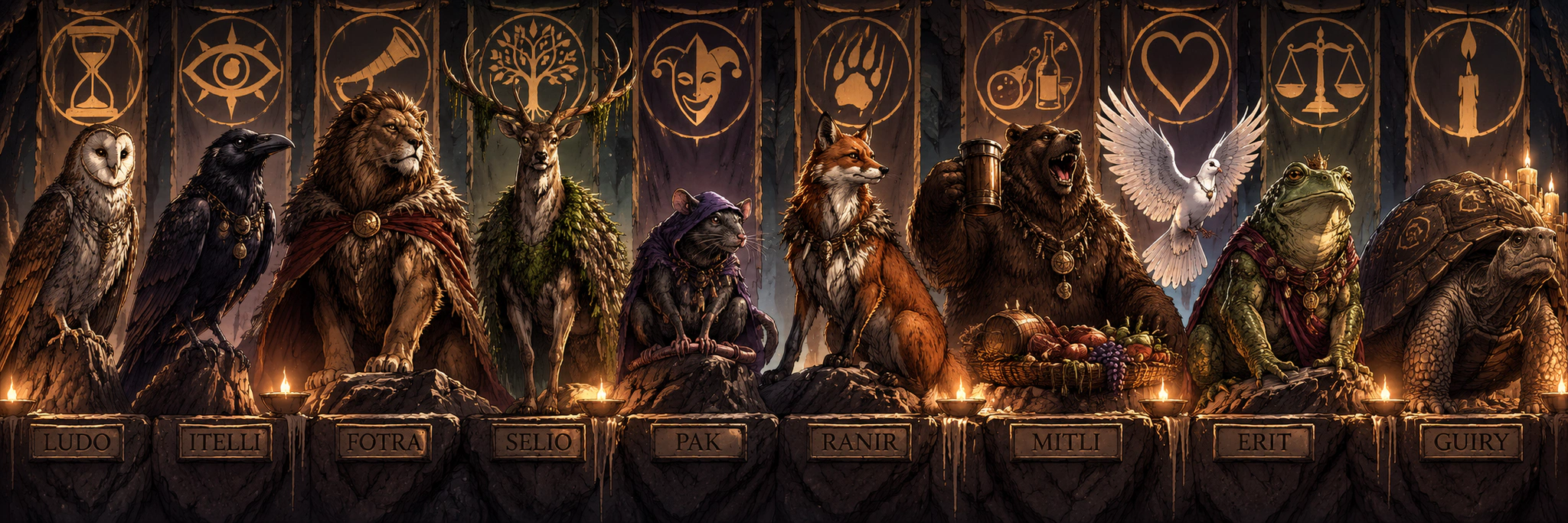
Forylis is the shared religion of the monstrous races. Its ten gods represent the different forces, experiences and values that shape monstrous life, and all monstrous peoples recognise the same pantheon.
Individuals, families, clans and Orders may favour particular gods depending on their lives and beliefs, but all ten gods are recognised as part of Forylis.
Ludo — God of Life & Death
Name: Ludo
Domain: Life & Death
Represents: Survival, new life, death and the passage of time.
Symbol: A sand dial, with the top chamber representing the life yet to be lived and the bottom chamber representing the life already lived and the memories left behind.
Commonly Worshipped When: A child is born, during dangerous times, when someone is close to death, or when someone dies.
Appearance: A large black and white wise owl.
Common Phrases:
"Please allow me more sand."
"Their sand has passed."
Itelli — God of Intelligence
Name: Itelli
Domain: Intelligence
Represents: Intelligence, ingenuity, understanding and the ability to see solutions to problems.
Symbol: An eye, representing the ability to gather and see knowledge. The eye can also represent the "third eye" sought when someone needs greater understanding.
Commonly Worshipped When: Someone is stuck with a problem, discovers a solution, or creates something new.
Appearance: A raven with deep, bold yellow eyes.
Common Phrases:
"Itelli, open my third eye."
"Itelli has shown me the way."
Fotra — God of Power, War & Strength
Name: Fotra
Domain: Power, War & Strength
Represents: Strength, power, courage, protection and warfare.
Symbol: A horn, representing the call to action and the moment when strength is needed.
Commonly Worshipped When: Before battle, during a crisis, when facing danger, or after winning a battle or fight.
Appearance: A great lion, representing strength, courage and power.
Common Phrases:
"I can hear the horn of Fotra."
"Fotra's horn is blowing for me/us."
Selio — God of Nature & Earth
Name: Selio
Domain: Nature & Earth
Represents: The earth, trees, plants, animals and the natural world.
Symbol: A vine intertwined with a tree, representing the interconnectedness and growth of the natural world.
Commonly Worshipped When: Nature provides something valuable, when witnessing particularly beautiful natural scenery, or when appreciating the natural world.
Appearance: A great deer with tree branches for antlers and vines hanging from its body.
Common Phrases:
"Bless Selio for this sight."
"Selio's vine has touched this."
"We are looking through Selio's branches."
Pak — God of Lies & Mischief
Name: Pak
Domain: Lies & Mischief
Represents: Deception, trickery, mischief, dishonesty, confusion and the deliberate creation of trouble or misfortune.
Symbol: A crooked mask, representing deception, hidden intentions and pretending to be something you are not.
Commonly Worshipped When: People need help conducting lies or mischief, wish misfortune upon others, or want to cause confusion.
Appearance: A grey rat with patches of black and a scratched eye.
Common Phrases:
"Pak has pulled the mask over them."
"Don't let Pak choose your face."
"Pak's mask is upon this."
Ranir — God of Hunting & Festivals
Name: Ranir
Domain: Hunting & Festivals
Represents: Hunting, successful hunts, competition, celebration and communal festivals.
Symbol: A claw, representing the skill and precision required to successfully hunt.
Commonly Worshipped When: Beginning a hunt, returning from a successful hunt, when a festival begins, and during major celebrations or competitions.
Appearance: A large, fluffy fox, well-fed but strong and capable of hunting.
Common Phrases:
"Ranir's claw will strike true."
"Praise Ranir and his sharp claw."
"Ranir's claw is digging into my head."
Mitli — God of Feasts, Food & Drink
Name: Mitli
Domain: Feasts, Food & Drink
Represents: Food, drink, feasting, hospitality, family gatherings and the enjoyment of sharing what has been prepared.
Symbol: A rustic medieval wine bottle and a piece of meat, representing good food and drink.
Commonly Worshipped When: Family events, gatherings, feasts, celebrations and when people have particularly good food or drink.
Appearance: A large bear, well-fed and visibly tipsy.
Common Phrases:
"Praise Mitli for this food and drink."
"We drink to Mitli."
"This is as strong as Mitli's wine."
"Praise Mitli, this is good."
Dira — God of Love
Name: Dira
Domain: Love
Represents: Romantic love, family, companionship, affection and the bonds between people.
Symbol: A heart, representing love and the emotional bonds between people.
Commonly Worshipped When: A marriage occurs, a child is born from a marriage, when wishing for someone's love, and when celebrating the love between people.
Appearance: A dove, representing love, peace and companionship.
Common Phrases:
"Dira, bless this couple."
"Dira, thank you for this child."
"Dira, please make her notice me."
Erit — God of Fortune
Name: Erit
Domain: Fortune
Represents: Luck, opportunity, chance, prosperity and the unpredictable nature of events.
Symbol: Scales representing fortune hanging in the balance and the hope that the scales will fall in your favour.
Commonly Worshipped When: Making a deal, negotiating, seeking wealth or prosperity, taking a significant risk, or hoping for a favourable outcome.
Appearance: A large, regal frog.
Common Phrases:
"Thank Erit for that deal."
"Erit, please can the scales be in my favour?"
"Come on, Erit knows this isn't balanced."
Guiry — God of Knowledge & Memory
Name: Guiry
Domain: Knowledge & Memory
Represents: Learning, history, tradition, wisdom, knowledge that has been gathered and preserved, and the remembrance of those who came before.
Symbol: A candle, representing memories being kept alive and passed from one person to another. One candle can light another, just as memories and knowledge are passed between generations.
Commonly Worshipped When: Knowledge is passed down, someone remembers something important, or someone needs to be reminded of a tradition.
Appearance: A grand old turtle, with notches and markings across its shell representing the vast amount of information and knowledge it carries.
Common Phrases:
"Guiry, please ensure this is passed down."
"Thank Guiry for remembering that."
"Guiry would be disappointed."